Showing posts with label Just a thought.... Show all posts

Tuesday, March 1, 2011

Documentaries and News Casting/Reporting

I started watching I-Witness Documentaries in Powerhouse QTV 11 last January. I felt like so acquainted to the said program alongside other current affairs shows such as Reporter’s Notebook and Jessica Soho Reports. It happened that I wasn’t able to follow the usual programs during my college years since we didn’t have a tv set in the apartment. I am just glad to know that the broadcasting company still air some replays of their documentaries. Whenever I am watching such real life-issues and stories presented by indeed very good reporters, I always end up wondering about the protocol a particular documentary program follows in selecting the right reporter to conduct the research and deal with a certain issue [too inquisitive ‘bout this matter eh?].

On News Casting and Reporting...

It’s not because I am messed up by the usual news personalities we see all day and night in news programs [they have established themselves in the course of time, anyway] but I’m again thinking that in their presence, the reporters or at least the far-more-experienced-than-reporters staffs couldn’t excel as anchors or news casters [or into a position such as those highly regarded in the studios]. We all know that both concerns have different matters to consider. Again, this is by all means a question by a person who’s only wondering bout what and how it goes in public affairs and journalism [and so whoever reads this and has any comments, feel free to give some].

Well, known to the concerned viewers, the roles of an anchor and a reporter are almost interchangeable [at least an anchor can grab that of a reporter’s but the latter can’t easily have an anchor’s position].  While the reporter gathers the news [of all encompassing aspects] in the field, the anchor stays in the studio to convey collected info through TV or radio networks. The former does everything at least from gathering and assembling info, voice casting and script writing while the anchor may or may not write the news as he/she will deliver it later.

Unknown to us [but of course may seem too obvious], an anchor’s rank is esteemed and highly paid [accdg to a friend of mine who’s working in a local network].


The return of Brigada

I highly commend Brigada for again venturing into this kind of conveying news to the public. There are really lots of public matters we tend to ignore just so because we, in general aren’t actually informed about the real scenarios in the society. For me, it is a good thing to have such program that will discuss local problems in the country whether in the rural or urban as I may say. For a public affairs’ pillar [GMA News] Jessica Soho, who’s been in the said field for years [way back Beltran and Sotto’s Brigada Siete], it seems to be her time to give back what she has received in the course of her stay in the department by mentoring the new generation of journalists/reporters. Though I was not really concerned with the news ‘til 4th grade, I knew there were running news programs like Hoy! Gising, Frontpage, Brigada Siete, Magandang Gabi Bayan, etc.  Through time, the people have in general changed preferences on how news are delivered. The contemporary time needs [well as I deem so] a progressive strategy to capture interests amongst people.  A touch of opinion in an unconventional news program like that of Brigada with small bits of documentaries shows how news programs respond to what the present time calls for. Also, let me speak well of it again as the program gives the reporters behind the limelight [reporters who appear infrequently] a chance to give some commentaries on their reports as Jessica shares her own insights as well. Whoa. I so love it. [If I am not into the field of science, I’d probably in journalism. kapal...]


John Mark Katindig Torres

Friday, May 21, 2010

Endeavours For a Worthwhile Sacrifice: Unveil the Significance of the Course

I enrolled myself in Literacy Training Service 2 on my last semester in 3rd year (2008-2009). It was in response to the required National Service Training Program units before I finish college. That experience made me realize the importance of including the said course in our curriculum. I got this archive from my folders when I was arranging my files. Hope you’ll end with some realizations or awareness of the true situation of the primary education in the Philippines.




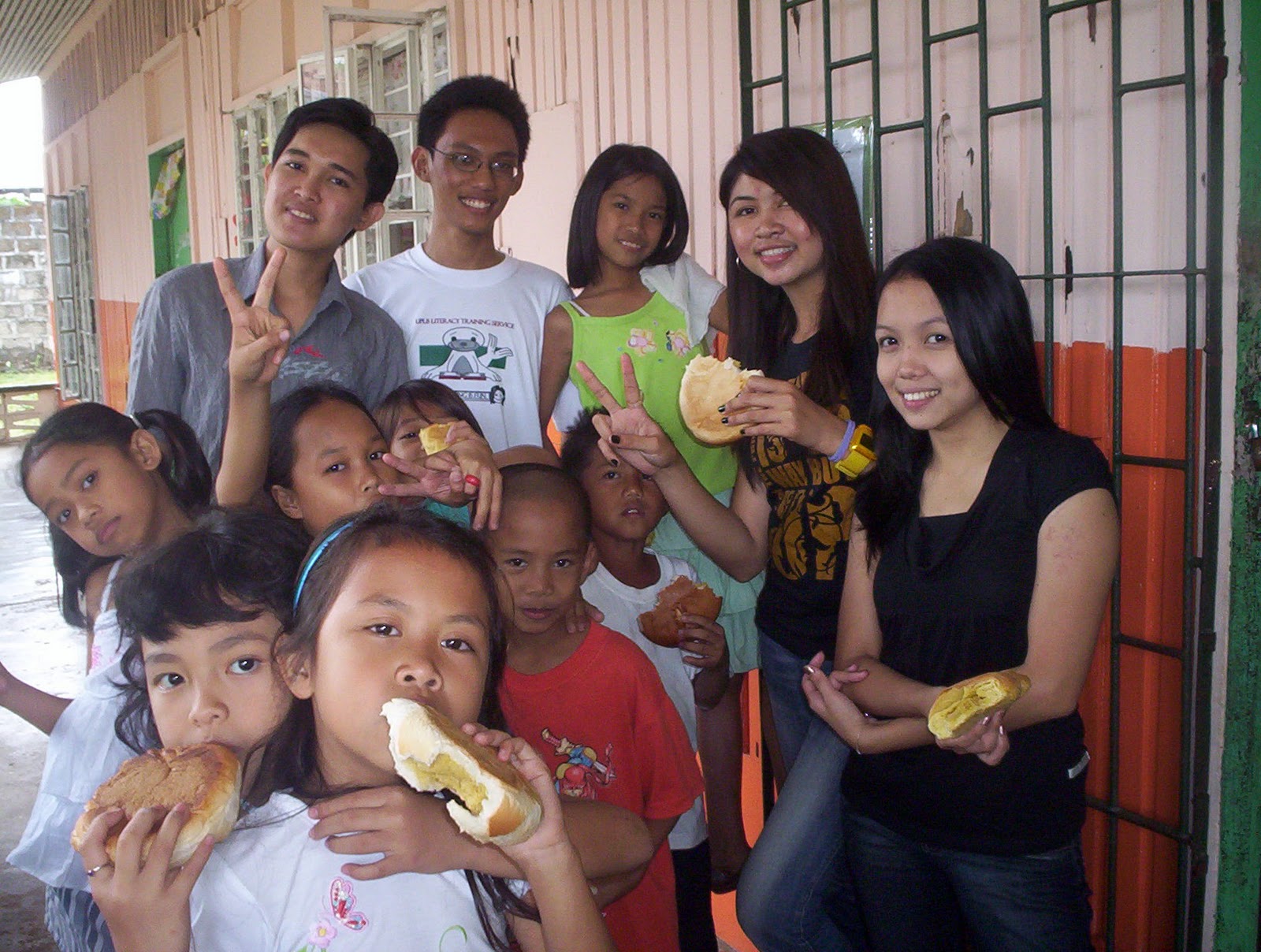
                    My first encounter with the Sta. Isabel Elementary School revolved around three points: the room where the class is being held and will be held unfortunately throughout the semester, my students of different backgrounds and characters, and the teacher who appeared to be so idle (that’s I guess the way I can describe her). First to deal with, though I am used to see old rooms and facilities in institutions like that, I was still surprised by the condition of the room. I used to wonder then how will our voices be heard well in the said room with outworn walls which are incapable of confining sounds. Luckily, I was still able to find some facilities like fans working well and the comfort room which is I believe an important portion too. With regards to the students, I may appear prejudicial but I do believe that they are truly friendly and approachable. Most of them as I have observed form groups and I think it might be because they really knew one another and that it is really the nature of kids. Boys form their own groups as well as the girls. Concerning my encounter with the teacher, meeting her, honestly, made me feel secured from the fact that the students are definitely dealing with a very good mentor during the course. The manner in which she delivered her ideas, experiences and perceptions was really convincing (at least that moment I asked her about the conditions of the students). The gestures she made contributed big points as she imparted every little thing she knew making her in the end (of our short conversation) very efficient in conveying her insights on the characters and performances of her students (academically and on behavioural aspect).

                    The students like any other kids of their age are very playful. Every time we facilitators allow them to take a break, they always proceed to the school yard and play vigorous games. Luksong baka I think was the game the boys used to play and which scared the hell out of me. During their recess, we facilitators still used to guide and watch them play and find their activity not safe for them. I have never been like that when I was still a kid, but no regrets because I chose not to. Anyway, I used to watch the girls too. It appeared that they tend to compete with the boys’ energy and activeness by playing similar games within their group. They were indeed very energetic. It’s as if that will be the last game of their lives. Oftentimes, they shout at each other, say bad words I didn’t expect those kids can utter. I wasn’t surprised yet knowing that those students have different backgrounds.

                    At first I appeared in front of the students as if I was just forced to do some “outreach” works in turn to pass the course but I realized then how important it is to attend to the needs of those students. Hard as it may seem and benefits from our works might be vague, the internal satisfaction of helping children understand things (academic matters) better is what I had learned to develop along the way. I also realized that it a part of returning what the Lord had given me, something that I can give in return to the kindness and the blessings our Lord showed, gave and made me feel.

                    I remember then the times where I used to wake up early in the morning to prepare for their class, to plan how the activity will be interesting and how can I make their day fruitful and worthwhile. That was indeed a worthwhile sacrifice. Honestly, it wasn’t easy to travel for about an hour to stay and teach the students, students I don’t even know after all, students I’m not familiar with. It had been a sacrifice both for our time and the money we spent for the trips’ fare, a sacrifice I realized that was very sensible.

                    I now understand the essence of life and the significance and purpose of my existence better than the way I have used to perceive it. I learned that I am not living in this world, that I am not here to be served but to serve my fellows. I realized that our country badly needs volunteers to conduct free services in teaching, livelihood and outreach programs and the like. We, who are able to acquire and enjoy lots of privileges, should give back in return the blessings, the luck and good opportunities we received and continuously receiving.

                    We can’t live alone and that’s a fact we should live with. Many of us want an ideal community but how can we reach that dream if we, who are capable of making changes in the society will not take the first step, show some initiatives that we are concern with such. Dreams will remain dreams for as long as we are not doing anything, for as long as we depend with one another’s presence, nothing good will happen. Our country can’t wait and it badly needs kind-hearted Filipinos who do not only recognize the country’s needs but also take response and actions for it.

                    In the course of our lives, there will come a time when we are to deal with people of different culture, outlooks and perceptions of life. The bottom line of these things is that there are many things we need to explore and understand in this world and that our lives should not revolve only in our chosen fields for life’s lessons (as I have experienced during the literary service) are best learned through socialization, acquaintances, experiences and offerings. I offered my time, a commitment I will never forget, a bond with people I didn’t even know in the first place, to the Grade 3 students of Sta. Isabel whom I learned to love, everything was worth it.

                    I am 20 years old and I know my country depends on me. I promise to do then my responsibilities as its citizen. Many of us then tend to lag behind the ideas of life and sacrifice and so I will promise myself not to be like those people who after had reached and touched their goals in life will not look back anymore to where they had been before. I will not let my country down and so will I for my fellow Filipinos. To understand what our country underwent through in time would be the very first thing we should develop. What follows then would be our response to the needs it has silently proclaiming for years.

                    The nature of human beings goes like this; one will not do something innovative, something that will induce changes unless someone who is prominent will take initiative. We barely depend on orders and laws that we believe can respond to the needs of our country but how long will it take for a proposal to be accepted, for an idea to be relatively put into an effective action? We need to resign ourselves and get submitted to the needs of Filipinos. After all, who can help our fellows but only we who have been taught of what can sacrifice and offerings do.

                    The magnitude of offering does not dwell only in physical manifestations. It can be thoroughly observed in the changes we can induce to the people we used to mingle and helped go along with their lives. The idea that we can lend a hand for them gives them hope and faith in their capabilities, to what an ordinary individual can do for the betterment of his surroundings, of himself. We are in this world to co-create with God by extending, by spreading His love for us. Life spent for any other purpose is meaningless. We must abandon a thought system based on fears that we are to do for our fellows will not do anything good to us for the joy it brings definitely boundless, implying the magnitude of its power that is on the hearts and minds of the people we can help. It is a way of leaving a good mark in this world full of doubts, fears and hopelessness. Let us bring hope, love and care by offering ourselves to the Filipinos, to the Philippines who badly need our assistance, who definitely after our sacrifices, who really need our attention, to build a strong sense of being a unified country that by all means will help one another achieve the goals of a wonderful and meaningful life. Let us take the first step towards the success of non-evanescent outcomes of our sacrifices and unveil the world with love for one another. Our life will be meaningless unless we take part of and touch the lives of other people. By affirming that we love our fellow Filipinos in every situation, we actualize then the power of sacrifice and offering. Let us make people feel love in their lives even though the world has become a rather loveless place.


John Mark Katindig Torres

Saturday, May 15, 2010

Ethical vs. Practical: The Case of Biotechnology

                  Safety must come first. Ironically, the biotechnology industry has done and is doing an excellent job in this respect, yet the thought of manipulating the very hereditary substance of plants and animals - our food - is hard to be accepted by traditionalists. While scientists deem genetically modified food safe, the public, particularly in Europe, will not eat it. Many consumer advocates and environmentalists are convinced that this wide production of GMO should be stopped.

                  There are supporters and opposers of this developing field of science. Ethical and practical concerns therefore should be considered. Caught by our grown up traditions and as dictated by the society, many of us tend to lag behind the progressing ideas of life and science.

                  Biotechnology as an application of biological knowledge can help improve industrial processes and food production. As a subset of genetic engineering it employs isolation of desirable genes from other organisms. These genes are then manipulated and incorporated to target products. Basically, genetically modified organisms (GMO) are organisms whose genetic material has been altered to come up with relatively more beneficial products. This is in response to increasing demands of people in time that should be satisfied.

                  Advocates of genetic engineering believe that advances being made with regards to GM foods offer a way to quickly improve crop characteristics such as yield, pest resistance, or herbicide tolerance often to a degree not possible to traditional methods. In turn, it can increase food security for growing populations and in poor countries which rely on crops as main staple of their diet.

                  A lot of worries on this concern also arise pertaining to fears that it is ethically unacceptable to interfere with nature and that it is against the very essence of humanity. Opposers also believe that there are potential negative impacts in biotechnology when in fact nothing has been proven.

                  Come to think of it. People tend to look and find faults whenever something new is discovered. Biotechnology has a lot to offer in medicine, agricultural and food industries. Isn’t time for us to move out of our bins and support biotechnology?

                  From the works of it, it does seem that the potential for biotechnology is boundless, thereby implying magnitude of power that’s in the hands of its advocates and practitioners. This is why it is faced with a range of controversies about its possible negative effects but scientists working in Biotechnology are not blind to these apprehensions.

                  Genetic engineering requires great precision. A large part of science involves learning how to make things better. Do we stop all scientific research because learning how to make things better also teaches us what makes them worse? God gave us intellect and it depends on us on how to use it. Biotechnology stands to give us better and brighter future. There’s nothing wrong in availing and accepting its wonderful products. Risks notwithstanding, biotechnology has more benefits to offer to humankind and it is time to support this field of science.


John Mark Katindig Torres
Wednesday, May 5, 2010

Reproductive Health Bill

                    Science and technology never exist in a vacuum. Inexplicably rational, they together even unfold in a definite context. However, envisioning all-encompassing factors, issues and proposals relatively raised by studies of science and technology are oftentimes are led off track. Because of this, we find ourselves caught in a nonetheless our own unsubstantial view of things. While we remain holding onto our beliefs, those we have grown up with, we tend to neglect the potential noteworthy positive effects of our discoveries regarded as those that can alleviate the society’s condition in general.

                    I’m here before you neither to encourage you nor to influence you the other way around regarding the concern of our group. Anyway, after all, at the end of the day, it depends on each one of us, among the factors raised, which one would sufficiently comply with our needs.

                    Generally, to weigh things in equity, here are the concerns of the RH Bill:

(1) Information and access to natural and modern family planning

(2) Maternal, infant and child health and nutrition

(3) Promotion of breast feeding

(4) Prevention of abortion and management of post-abortion complications

(5) Adolescent and youth health

(6) Prevention and management of Reproductive tract infections, HIV/AIDS and STDs

(7) Elimination of violence against women

(8) Counseling on sexuality and sexual and reproductive health

(9) Treatment of breast and Reproductive tract cancers

(10) Male involvement and participation in RH;

(11) Prevention and treatment of infertility and

(12) RH education for the youth.
                    Disregarding any selfish concerns that might be prevailing among the proponents of the bill, as rational beings, we all know that this would not arise if we sufficiently are equipped with necessary tools to progress as a society. Population is not a burden and it will never be as long as (in a conditioned premise) the society can undergo sustainable development concerning the environment, maintain resources and preserve the instilled culture and tradition the society is born with. There’s actually no need to interfere with the natural process of reproduction, but as it remains inevitably a great concern for the whole society’s capability of pronouncing its needs, there arises the need to partake the very essence of humanistic method of abreast of the setbacks related to it.

                    While this kind of bill is proposed, a number of different social issues and concerns also merit a careful consideration. For an instance, one may inquire up to what extent will the domination of researches and developments impede or promote the civilian concerns and to the whole humanity at stake. How should the proposals be funded and organized and be maintained sustainably for the citizenry? And lastly, how can the society sit assured of the benefits they will enjoy while preserving their innate ideational, societal, personality and material perspectives as a whole? While these three questions may appear perplexing, it only suggests that to comply with causes and consequences of our schemes, it is a requisite to always mull over the potential constructive effects and underlying ethical conflicts it may pose.


Tuesday, April 27, 2010

On Technonolgical Advancement Disparities

       When I took STS 1 (Science, Technology and Society) subject during my last semester in college, I've recognized a lot of factors on why our country, in the field of science and technology, is incompetent as I may say so, with that of the first world ones. This is of course a big issue to deal with and there would definitely be underlying aspects to consider. Anyway, as far as I'm concerned, maybe, just maybe, everything roots to the following reality bites on technological disparities.

- Myriad Complex of Issues (multitude of factors, e.g. government funding, availability of resources, manpower, technical-know-hows, etc.)
- Strong Will in Pursuance of Technological Advancements (individual and organizational wills)
- Stringent Operational Implementation from Comprehensive Researches (laws and orders from the research agencies, institutes, academes, etc.)

         Countries who can afford to conduct and perform researches for further advancements bear the label of having supreme qualities for both products and services. They who have established their names in the global market as leading nations in the field of science can be attributed to the support from the government they receive and enjoy in time.
          Well, with great hopes, the Philippines will in time enjoy highly-defined technological advancements...

Saturday, April 10, 2010

Hero


Inspired by Efren Penaflorida's good works, I made this piece on a new perspective about a hero.


Hero. Is he a brave man, a conqueror, an idol for few, or an individual of great deeds? What makes a hero? What must one do to be regarded as a hero? Just few questions that bothered me that for long, I have been enjoying this freedom of speech, expression of one’s thoughts and opinions and a lot more privileges of a freeman, but never did it come to my mind, who were those individuals who might had offered their lives in pursuing such freedom. An attribute as I may say, “hero” is such a one word with scores of definition; of which one base on my perspectives is as follows.

Pondering on aforementioned questions, I ended up realizing that there might be no existing set of rules or criteria in identifying who among the historical figures will bear the label of being a hero. To some extent however, all of our fellowmen regarded as heroes possess some sterling qualities of which patriotism predominates all. They who had their contributions in the process of nation building and the induction of mind awakening events made people realize of the significance of liberty in any possible perspective we can think of. It has been an established idea to all of us that heroes are those who live in the very sense of nationalism, whose aspirations dwell mainly on struggling for freedom. If we are to contemplate on what a hero really means, there arise thus the need to mull over the idea that heroes are not just those who carry with them noble qualities. For me, people whom we encounter everyday can also be considered as heroes. They may not be distinguished for any courageous act or abilities nor admired for heroic deeds, but they who have been doing their jobs to the very best they can, without harming but rather offering best services to other people can also be regarded as a hero. To my concern, there are those people who stay in shadows, out of spotlights, and overlooked everyday but whose existence links the lives of other significant people.

For me, a hero is someone who makes impact to the lives of the people around him. Teachers, policemen, fire fighters, maintenance staffs, electricians, domestic workers and the like are, for me, my heroes. They can teach you to read or write, they can save you in various ways and indeed, they can really make a huge difference in your life. I adore them who fulfil every inch of their profession, every response to the need of the contemporary society. True heroes are the people that do not think about being a hero; they just do what is instinctive to them and then do not delight in the glory of their actions. They are all before our eyes; unappreciated and insignificant yet they play noteworthy roles to improve and extend our lives.


John Mark Katindig Torres

Sunday, October 18, 2009

Sine qua non: Persuasive Call for Action


Rising sea levels, increased rainfalls and flooding, heat waves, droughts and wildfires, crop failures and spreading of contagious diseases…

To what forces do we attribute these adversities? Are they mere natural occurrences? Think again…

Earth is indeed facing a disastrous end. Aforementioned events are just signals of a long-term rise in the world’s condition. For years it has been a question as to what might have caused these life-threatening episodes we experience, not realizing that the activities we perform essentially lead to these destructive phenomena. Yes, we have successfully identified it, the global warming, but we always tend to skirt the issue and live our lives the way we want it. We burn gasoline, coals and other fossil fuels inefficiently for energy; we cut down trees for paper industries without even replacing it; we utilize meats incompetently; we intervened natural processes of our ecosystems; all actions invading, all destructive. We keep on exploiting the environment as if we don’t know what the outcomes will be. Global warming is truly not just a natural occurrence but rather the consequence of our activities. We regard ourselves as far the most advanced group and yet we are not able to recognize how our existence and way of living distress other life forms inadvertently. We think we might belong to the predicted extinction of species that could be driven about by the tremendously worse effects of our undertakings but do we make actions regarding it.

While the humankind has the ability to obliterate, we can also act to sustain and preserve our planet in general. Unless it has been clear to our minds that our concern here is how we can stop the world from approaching its end, we will never learn to appreciate the very essence of life. While scientists dwell on this big deal issue for remediation, we, ordinary individuals can make a change by ourselves. Resolutions are like ABCs; by reducing carbon and green gas emissions, by driving less, by using energy-efficient lamps, by cutting down garbage, frequently using dishwashers and dryers, by recycling papers, by limiting use of plastics, by consuming farm fresh goods, and by using nontoxic cleaning products. Enacting these simple activities will surely not relegate the quality of our lives. These will even alleviate our dilemmas that seemed to be out of our control. It is by the time that we make our moves that this world will become the best place to live in.

The future is not somewhere we are going. We gently hold it as if it is an infant too delicate to handle; we mold it as if it is a glass too fragile to hold with; and we craft it as if our whole existence depends on it. In this real story of life, let us not serve as villains who will drive Earth near its end. A paradigm shift is what we need. Endure the pain of sacrifices and enjoy the goodness of life in return as we attempt to extend years of existence to our planet.
Powered by Blogger.